The first time I ever truly meditated, I was sitting in a circle with fourteen women inside a federal prison.
I was there to teach and they were looking at me like I had all the answers. The truth was I was thirty days into having googled my way into understanding what meditation actually was.
I was teaching a class called Houses of Healing. The curriculum called for meditation, and I had a rule for myself: I wasn’t going to ask the people I worked with to do something I wasn’t willing to do myself.
So a month before the course started, I read everything I could find. The book that clicked for me was The Mind Illuminated, which I recommend to anyone trying to build their meditation practice. It dismantled almost every assumption I had and really taught me HOW to meditate.
Then I walked into that room, sat down in a circle with the women, and we did a guided body scan together. They thought it was awkward, I thought it was awkward, but we did it anyway.
One woman in that circle told me flat out she could not meditate.
She was engaged, she was trying, she wanted to be there. Meditation was just the thing that felt impossible to her. Too hard, too unfamiliar, too much stillness for a mind that didn’t know how to stop (let alone in a place that was never quiet).
I gave her a challenge. I asked her for that week to just try and meditate for five breaths. That was all, just five breaths.
She came back the next week so proud of herself. She had done five breaths every day since I had last seen her. I upped the challenge to ten breaths. Eventually we stopped counting because she didn’t need the challenge anymore.
You start by surviving five breaths. And then you survive five more.
Most people quit meditating because they think they’re failing at it.
You sit down, focus on your breath, and you’re doing okay. And then out of nowhere you’re thinking about what you want for dinner, or that text you forgot to send, or something someone said to you three weeks ago that you’re still annoyed about.
And you get frustrated, thinking you can’t do it. You get up and decide that meditation is not for you.
What I learned, and what I tell every class since is that the drifting is meditation.
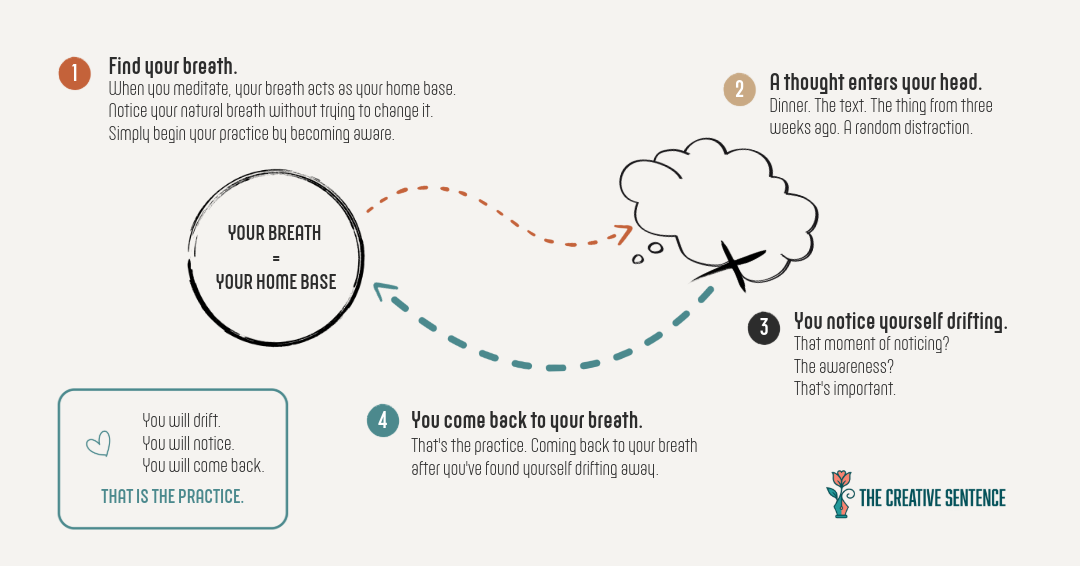
This is the diagram I draw on the board every time I teach. The whole practice lives in that loop: drift, notice, return. If you can do that once, you can meditate.
So when you get distracted, which you will, remember the diagram.
I get asked a lot if meditation is a religious practice.
Some people with strong religious beliefs worry that meditation is Buddhist and therefore not compatible with their faith.
Here’s what I tell them. Meditation is used heavily in Buddhist practice, yes. But it doesn’t belong to any one religion. If you’re religious and you want to use meditation to deepen your connection to God or your faith, that’s completely valid.
Let me be honest about my own practice.
Because I think it’s important that you know I’m not writing this from a place of having it all figured out.
I have a meditation area in my sunroom complete with a green cushion, a small floor desk, and a writing pad. When I’m consistent I feel the difference in all areas of my life. I’m clearer, calmer, more present. I know this about myself and others notice it, too.
And I still go weeks without sitting on that cushion.
It’s not because I forgot how or because I stopped believing in it. But because I’m human and habits are hard and sometimes life goes by and before you know it it’s been weeks.
Even the people who teach it, who’ve watched it change their own lives, lose the thread sometimes. The practice isn’t holding a perfect streak, it’s knowing how to come back.
What my practice actually looks like when it’s working.
I use the Daily Trip on the Calm app because my brain does better with guided meditations. Each Daily Trip has a theme or teaching for that day. Immediately after I finish I write notes of what I took away.
I do this because I’ve always been a learner at heart and connecting something back to something tangible helps it stick. It also means I have a record, pages of little moments I can go back to.
I used to need a physical anchor to meditate. I used my hand on my stomach, it was something concrete I could come back to when I drifted. Now I can follow my breath alone. That shift took longer than I expected and came with a lot of practice.
If you’ve never meditated before, or you’ve tried and quit, here’s where I’d start.
Download an app like Calm or Insight Timer. Both are free to at least try out. YouTube has guided meditations too if you don’t want another app.
Find a guided meditation that is five minutes long or so. Sit somewhere quiet. When you get distracted, and you will, remember the diagram. Notice the drift, come back to your breath. That moment of return is not failure, it’s the whole point.
I think about that woman in the circle sometimes. The one who told me she absolutely could not do it and then came back the next week having done it.
She wasn’t naturally still or calm. To be honest, she wasn’t anything that we typically associate with meditation. She was loud, rambunctious, and full of energy. But the thing that mattered most was that she was willing to try five breaths.
That’s all it ever takes to start.
The Creative Sentence is a self-paced emotional literacy and creative writing workbook built around the practices that help you reconnect with yourself. Each lesson includes a grounding practice designed to help you slow down before you write. Grab a free meditation guide [here].
